
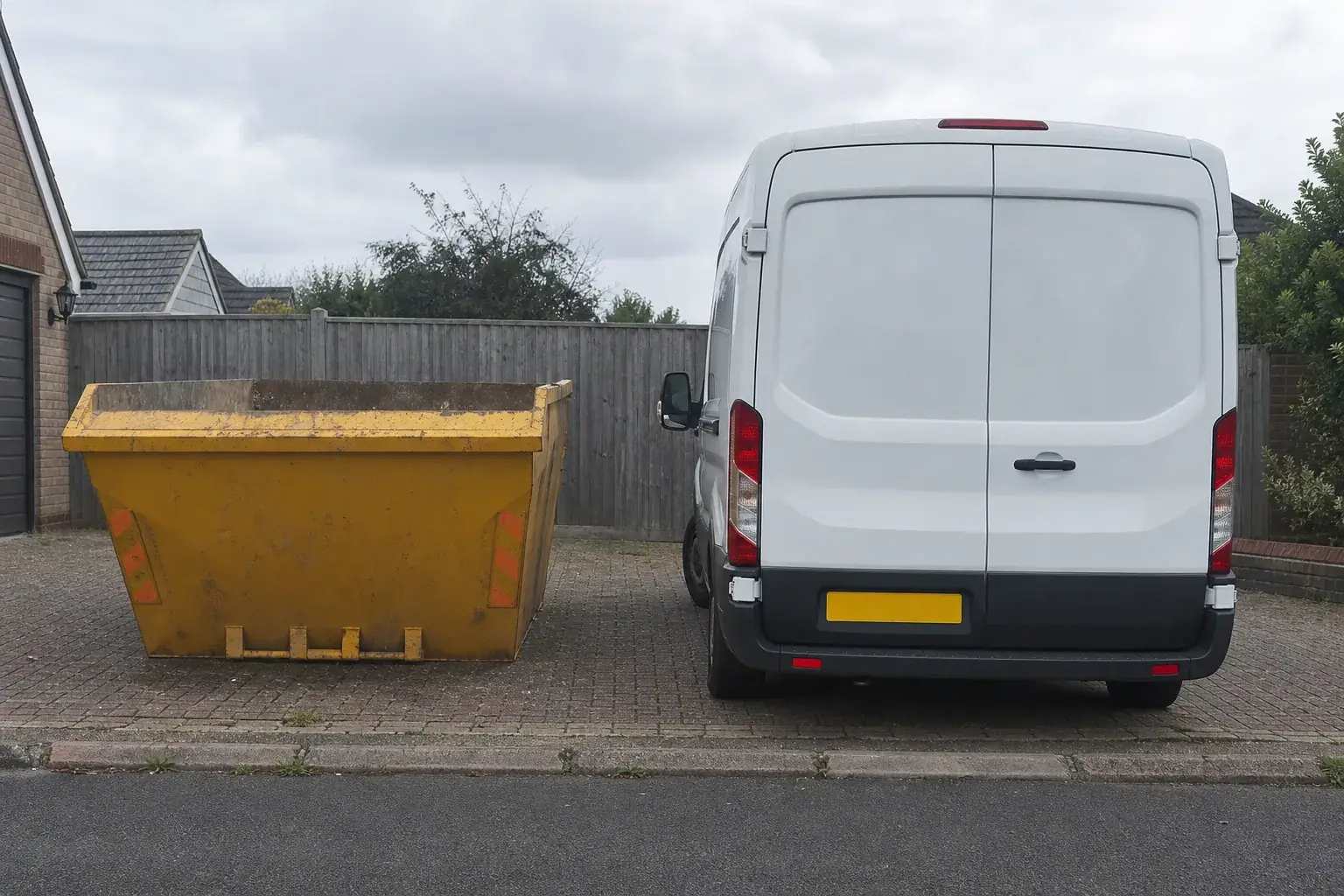
The basic difference
A skip is a container hired for a period. It is delivered, left with you, filled by you, and collected. You pay for the size of the container and the length of the hire, whether you fill it or not.
A man and van is a service. A vehicle and a team arrive, load what you point at, and leave. You pay for the volume actually taken and the labour involved.
Everything else follows from that. A skip gives you time and costs you effort. A van gives you effort and costs you flexibility about when.
Cost
Compared purely on price per cubic yard, a skip is usually cheaper, and anyone telling you otherwise is selling something. What that comparison leaves out is that it assumes you fill it.
The common outcome with a skip is a container two-thirds full, because people size up to be safe. You paid for the third you did not use. A man and van charges for the space your load actually occupies, so a job smaller than expected costs less rather than the same.
Then there is the permit. A skip on the public highway needs one from the council, which is an additional cost and takes time to arrange. On a private driveway it does not.
And there is your time. Filling a six-yard skip is a real day of lifting. Whether that is worth paying to avoid is a personal judgement, but it belongs in the comparison rather than outside it.
Access, which usually decides it
A skip needs somewhere to stand, and it needs a lorry to reach that place. In a terraced street with no driveway and residents parking, that frequently means a road permit, suspended bays, or simply nowhere legal to put it.
A van needs somewhere to park for an hour. That is a much lower bar, and it is why man and van collections dominate in flats, terraces and anywhere with controlled parking.
The other half of access is the property itself. A skip on the drive does not help with a wardrobe on the second floor. Carrying is included in a man and van collection and is not included in a skip.
Time
This is the clearest division of the two.
Waste that appears gradually over a fortnight of work wants a skip. Repeated van visits for a bit at a time is the expensive way to run a renovation, and a container you can throw things into as you go is exactly the right tool.
Waste that already exists, in a pile, today, wants a van. There is nothing to wait for and no reason to pay for a week of hire.
Weight
Heavy inert material behaves differently. Soil, rubble, concrete and hardcore are dense, and both options price them by weight because disposal is charged that way.
For large quantities of it, a skip or a grab lorry is usually the better answer, and a van will hit its legal weight limit long before it looks full. A van load of rubble is a much smaller pile than people expect.
A straight answer
Choose a skip when the work runs over days or weeks, when you have private space to put it, when the volume is large and heavy, and when you are content to do the loading.
Choose a man and van when the waste is already there, when there is nowhere to legally put a skip, when items need carrying out of the building, and when you would rather the job were finished this week than started this week.